
Editor's Note, 08/06/2013: I've recently noticed that this post has been used on a few forums to help advance certain discussions. I've not posted these myself, but I would appreciate a message or comment to let me know that it is being referenced so I can defend my work myself. If you have any questions or otherwise, please feel free to contact me directly! Thanks! And enjoy the blog!

I've been encouraged to post this, so here it is. This is the "dumbed down" version because I seem to have misplaced the original. I wrote this as a controversial topic paper for an English class. I was asked to dumb it down and make it more "emotional" as it was going to be entered into a competition for publication. Unfortunately (or fortunately, depending on how you look at it) my paper failed to make it past the initial nomination for being "too radical" and being surpassed, instead, by an asinine essay about waffles and a disjointed piece about how little boys should play with barbies, and little girls should play with army men.
Hmm. That sounded bitter. Yeah, I'm a little bitter. Those essays were horrible.

The battle of Thermopylae remains one of the most famous
war-stories in the west. Considered a
pyrrhic victory for the mighty Persian army, it's strongest influence is on western
culture, where the battle is regarded as exceptionally symbolic of patriotism
and courage against overwhelming odds.
Xerxes, the Persian leader sends an envoy to the defending Spartans
demanding they lay down their weapons.
Upon hearing this, Leonidas, leader of the Spartans replies with the
legendary phrase: "ΜΟΛΩΝ ΛΑΒΕ" (Come and Take them.) This has become something of a motto for 2nd
Amendment rights activists the world over.
"A well regulated Militia, being necessary to the security of a
free State,
the right of the people to keep and bear Arms, shall not be
infringed."
U.S. Constitution, Amendment II

As a young person, I held a very liberal viewpoint on the
ownership of weapons. I did not believe
that it was necessary, and I thought that the only people who would own guns
were crazy people. As I matured, I
learned that these weapons were used in a multitude of ways, not the least of
which was self defense. My true
conversion to an understanding, acceptance, and belief in personal gun ownership
for self defense reasons came when I married my wonderful wife. She was one I needed to protect, and the
prospect of having children brought into stark focus the reality and need to
protect my family. This later blossomed
into an understanding of the need to protect my loved ones not only from
immediate threats, but also future threats which could stem from an unregulated
and oppressive government. In my
studies, I have attempted to apply an original intent and original meaning
definition to the text of the second amendment.
It is every American's duty to know the Constitution of the United
States, understand the text in a relative nature, and defend its precepts as an
individual's rights to liberty demands.
Of special note and import is the second amendment of the Constitution,
as provided above.
The importance of the idea in which the general populace demanded
an individual right to bear arms is best understood with the writings and commentary
of contemporaries to the Constitution.
At the first writing of the Constitution, there was some negative
response from the populace about the lack of certain individual rights and the
necessity of limiting the newly formed government. Many of the rights demanded by the people are
now the first of the amendments to the Constitution. It was important to the people to maintain
certain explicit rights, chiefly among them being freedom of speech, religion, and
press, freedom against unwarranted search and seizure, and the distinct and
clear right to bear arms. The convention
of New Hampshire requested adding the following as an amendment to the Constitution: "Congress shall never disarm any citizen
unless such as are or have been in actual rebellion." (Elliot 326) This was also clearly defined in Pennsylvania's
requested amendments to the Constitution when they notated the following for
inclusion to the national Constitution: "That the people have a right to
bear arms for the defence(sic.) of themselves and their own state, or the
United States, or for the purpose of killing game; and no law shall be passed
for disarming the people or any of them, unless for crimes committed, or real
danger of public injury from individuals...." (Storing & Dry 151) Thus we can and will see the idea of an
individual right to arms was a well established idea among the populace. With these facts in hand, the intent and
meaning of the Constitution cannot be misunderstood.

The second amendment is divided into two portions, a prefatory
clause and an operative clause. Both
clauses work in conjunction to one another to provide the understanding
necessary to determine the meaning of the text.
The prefatory clause is the first part of the statement, and is written
as follows: "A well regulated Militia, being necessary to the security of
a free State," To determine intent
and meaning, it is important to understand the contextual meanings of each word
provided here, and come to a conclusion as to the importance of this prefatory
clause in general. Firstly is the use of
the word "Militia." What is a
Militia, and how can we know the difference between 'well regulated' and otherwise? At the signing of the Constitution we know
the Militia was generally understood to mean all male, able bodied people
within a certain age range. (Chemerinsky 17) This is generally a choking point for many
who would argue that the wording of Militia here in the prefatory clause is
meant to differentiate between "military" and "civilian"
people. This distinctive usage is not
the case. As provided in the definition,
the Militia included ALL male able bodied people within a certain age range,
without discriminating based upon training or induction into a branch of the
military as created by Congress. The
"military" at this time existed only as the Continental Army, formed
under the direction of the Continental Congress. The Continental Army was created to better
regulate and coordinate the Militias of the various states in the war of
American Revolution and was not meant to be a long-term standing force. The framers and people understood that no
standing army existed, but the Militia was existent simply because the people
were armed. In the Constitution itself,
the Militia is openly named as something already existing: "To provide for
calling forth the Militia to execute the Laws of the Union, suppress
Insurrections and repel Invasions;" further detailed by stating Congress
would not have the power to "create" a Militia, but simply to
"organize" the same. (art. I, cls 15-16) The language of the Constitution is clear,
especially when compared with language in other parts of the same
document. The powers to
"create" and "organize" are purposefully distinct, as shown
in Article I clauses 12-13 wherein the power is given to Congress "to
raise...armies..."
Believing the prefatory clause of the second amendment limits the
ownership of arms to only members of the military is to deny the operative
clause which states: "the right of the people to keep and bear arms, shall
not be infringed." It was generally
understood, and is still understood today, that the term "the people"
meant all persons, period. The operative
clause determines not only WHO owns the right proscribed, but also WHAT right
it is which they hold. The who are the
people, the what is the right to bear arms.
The importance of this right is best understood in the context of recent
history as it pertained to the people at the time of the founding. The United States was a new nation, forming
out of the ashes of revolution wherein the people revolted against tyrannical
rule and unchecked suppression. It is
common understanding and belief that for tyranny to prevail the populace must
first be disarmed. The tyrant doesn't
disband the Militia, for the Militia exists only so far as the people are
armed. An unarmed populace is a
non-existent Militia. The prefatory
clause includes the phrase "being necessary to a free state" and
defines the reason for the right to exist.
A free state cannot exist without an armed citizenry. Many are the detractors of this essential
right who would claim the law existed mainly as a means to hunt and for
personal self defense. While this may
still hold true to some small extent, the main purpose of the second amendment
was to proffer unto the people a means whereby they might protect themselves
from all forms of tyrannical rule, both foreign and domestic.
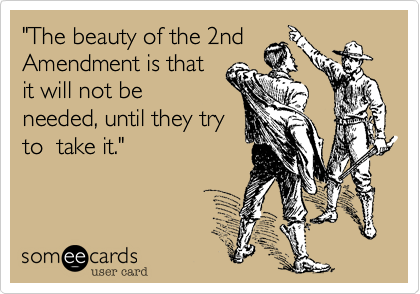
Those who question the need for a modern armed citizenry belie
their ignorance of recent and current events.
While Hitler and his Nazi party did not implement gun control laws on
the general populace themselves, the restrictions were already put in place by
the preceding Weimar Republic in an attempt (ironically) designed to disarm the
Nazis and Communists in the country.
When the Nazis came to power, it was made all the more simple for them,
as any weaponless resistance is a toothless one. Later, the Nazi party would go on to
implement stricter gun control laws on the populace, particularly restricting
Jews and other "non-citizens."
While this is not the defining component or only missing obstacle in the
rise to tyrannical power of Hitler and the Nazi party, it is certainly a
factor.

In modern times, Britain has instituted the toughest firearm restrictions in any democracy, and it's violent crime rates have skyrocketed. This approach never reduces violent crime, but only leaves law-abiding citizens at the mercy of criminals who know their victims have neither the means nor recourse to defend themselves. (Malcolm n. pag.) The United Nations Office on Drugs and Crime statistics show that after all private gun ownership was banned in 1996 there was a brief spike in gun related homicides before the rate and numbers again decreased. However, this decrease has rarely fallen below pre-gun law levels and are often equal to or greater than the rates from before. (UNODC, n. pag.) The need for personal ownership of weapons was made poignantly clear to me when watching news casts from the 1992 Los Angeles riots. In one shot, a man was standing on the roof of his home, assault rifle in hand. He was alone, there were no police in sight, yet the unruly mob was kept at bay. The man never fired a shot, but his having the weapon in hand was deterrent enough to protect his rights and property from those who would have forcefully taken and destroyed it.


When determining the importance of any individual rights, but
especially second amendment rights, it is important to determine
governorship. The United States of
America is a great experiment in government by the people and for the people. The introduction of the Constitution is clear
in who the governors are: "We the People...do ordain and establish this
Constitution for the United States of America." The people are the governed, and they govern
the United States, not the other way around.
It seems apparent as time goes on, that as the Federal Government of the
United States becomes stronger, the People become smaller and weaker. This should not be and it was for this
express purpose which the second amendment was produced. The three main branches of government were
created as a system of symbiotic checks and balances to ensure that none of the
other three branches became too powerful or overbearing. The right to bear arms was the check to balance
the power of the people against the central government. In the end of all things, the question can be
asked: who is governing, and who is governed?
The Constitution is clear on the answer to these questions, but as time
goes on this seems to get muddied in a central government's grab for power, and
weakened with the infringement of the people's ability to defend themselves and
their rights. Some would argue that an
under-armed and practically unfunded North Vietnamese insurgency which held its
own against the U.S. military, arguably the greatest military power at the
time, all without the protections guaranteed in the second amendment, is proof
positive that those provisions and ownerships were not needed. While it is true that the Vietcong held out
almost 25 years against a technologically superior force before the United
States finally gave up, what needs to be remembered, is that while the Vietcong
were outgunned and outclassed, they held their own because they were armed.
When confronting the text of the second amendment, wherein it states
the rights of the people "shall not be infringed," a sensible man
asks, where is the line? Where is the
border between arms and infringement?
The current climate of second amendment controversy surrounds the
question of whether or not people should be allowed to own assault rifles. What about other, and larger, weapons? Opponents argue saying the founding fathers
did not foresee the advances which would be made and thus the rights MUST be
infringed. Disputations have been raised
saying the second amendment applies only to single shot weapons and/or
muskets. As we have seen before, this is
patently false. Just as the first
amendment provides for protections regarding modern forms of communication, the
second extends in the same fashion to all instruments which constitute bearable
arms, "even those that were not in existence at the time of the
founding." (Chemerinsky 15)

The
provision of the second amendment is clearly for the defense of the civilian
against the government. It is therefore wise
to assume that the populace must be armed as the government is armed. This still leaves us with questions,
particularly in regards to unconventional weapons such a SCUDS and Nuclear
warheads. I pose a rhetorical question:
Had the citizenry been armed as the government is armed without infringement,
would the nuclear bomb have been invented?
While these arguments border on the frivolous, I maintain that the
people must be armed as the national military, I find the second amendment's
use of the words "Militia" and "keep" useful in defining
what individual citizens can maintain and what they should not. I don't believe the founders wanted each
citizen to have a cannon in their home, however, I do believe they would expect
a cannon to be in the possession of the Militia as a whole, to be regulated,
kept, and put to use appropriately and accordingly.

With all of this in mind, it bears remembering that not all men
are responsible or upright in their dealings with their fellow man. Where do we find the balance between security
and liberty when it comes to the right to bear arms? Benjamin Franklin famously opined: "They
who would give up essential liberty to obtain a little temporary safety,
deserve neither liberty nor safety." (Franklin & Franklin 142) I believe an appropriate understanding of the
balance is provided by Chief Justice Parker in an 1825 libel case wherein he
says: "The liberty of the press was to be unrestrained, but he who used it
was to be responsible in cases of its abuse; like the right to keep fire arms,
which does not protect him who uses them for annoyance or destruction."
(Chemerinsky 18) It is my right as an
American to choose for myself, and to defend myself. A policeman's weapon exists to protect the
policeman, not to protect me or my family, that is my duty. It is my duty to deal with my fellow man, to
understand the risks associated with those dealings, and to act accordingly in
order to mitigate any damages committed against my person or my loved ones.

In attempting to understand any part or portion of the Constitution,
I believe it is important to dig deeply into the rich history of our nation's
founding, and to seek out the various perspectives of the founding framers, and
the states who helped form the Constitution as it stands. An understanding of their circumstances leads
to an understanding of their ideas as put forth in the Constitution and Bill of
Rights. The provisions were put in place
to protect the few from the overbearing many, and also to protect the many from
the uprising few. The government of the
United States as provided to us by us
in the Constitution is both delicate and strong. We as People must actively participate in the
governorship of this great nation to ensure the rights of all men be protected,
and that our liberty and freedom be never infringed or taken from us. We must maintain our liberties, and our
rights to choose our own destinies. To
put that choice in the hands of a government is to give oneself to slavery. We must stand up and protect our rights. We must understand the great responsibility
we have to our children and fellow man, and we must fill ourselves with the
revolutionary spirit of Patrick Henry, and forever declare in our hearts:
"Give me Liberty, or give me Death!"
References
Chemerinsky, E. (2009). Constitutional Law (3rd ed.). New York,
NY: Wolters Kluwer.
Elliot, J. (1836-59). Elliot's Debates (2nd ed.).
Philadelphia, PA: J.B. Lippincott & co..
Franklin, B., & Franklin, W. T.
(1808). Memoirs of the Life and Writings
of Benjamin Franklin. Philadelphia, PA: T.S. Manning.
Malcolm, J. L. (November 2002). Gun
Control's Twisted Outcome. Retrieved from
http://reason.com/archives/2002/11/01/gun-controls-twisted-outcome
Storing, H. J., & Dry, M. (1981). The Complete Anti-Federalist. Chicago,
IL: University of Chicago.
UNODC - United Nations Office on Drugs
and Crime.. (2012). UNODC Homicide Statistics.. Retrieved from
http://www.unodc.org/unodc/en/data-and-analysis/homicide.html


